When you order an engraved cutting board as a gift, the engraving gets all the attention and the wood is treated as an afterthought. That is backwards. The species you choose decides how the board feels under a knife, how long the engraving stays crisp, how often the recipient has to maintain it, and what it costs you. Maple, walnut, cherry, and bamboo are the four you will be offered most often, and they are genuinely different tools, not just different colors.
Here is how the common choices compare on the things that actually matter for a board that will be both used and displayed, so you can match the wood to the person rather than defaulting to whatever is cheapest.
Hardness: the knife-friendly sweet spot
Wood hardness is measured on the Janka scale, and cutting boards live in a surprisingly narrow band. Too soft and the surface scars quickly and soaks up moisture; too hard and the board fights the knife, dulling the edge and giving an unpleasant, bouncy feel. The practical sweet spot sits roughly between 900 and 1,500 pounds-force, and the classic board woods cluster right inside it.
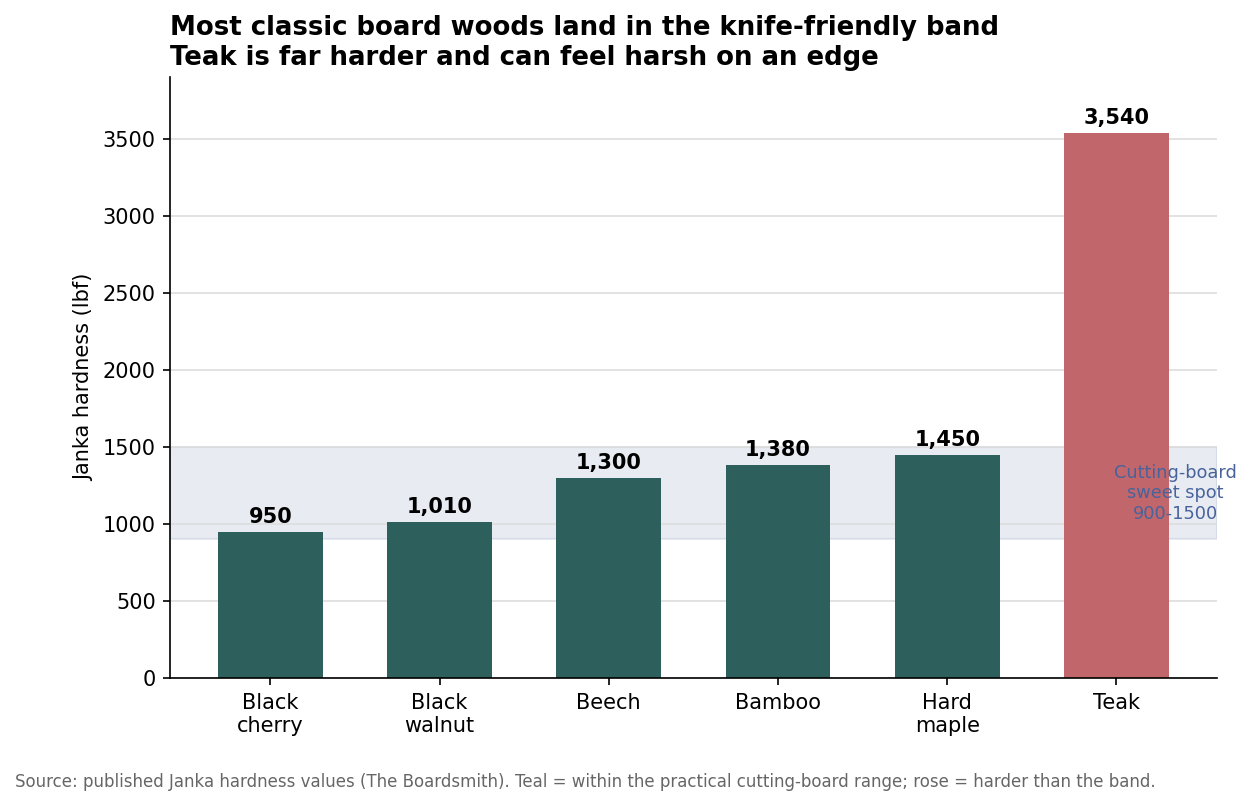
Hard maple, at about 1,450, sits near the top of the useful range, which is why it has been the butcher-block standard for a century: durable enough to resist scarring, still forgiving to an edge. Black walnut (around 1,010) and cherry (around 950) are softer, kinder to knives, and show cut marks a little more readily. Beech and bamboo land in the middle. Teak is the outlier at roughly 3,540; it is beautiful and water-resistant but hard enough to wear knives faster, and its natural silica content compounds that. For a board someone will actually cut on, staying inside the band is the safe call.
Grain, oil, and keeping it hygienic
Hardness is only half the story; the grain structure decides how the board handles moisture and bacteria. Maple has a tight, closed grain that resists liquid penetration, which is part of why light maple is the default for food prep. Walnut has a more open grain that drinks oil more readily, so a walnut board rewards more frequent conditioning, on the order of every six to twelve months for a board in regular use, against maybe once or twice a year for maple. Cherry sits in between and tends to absorb odors a little more than maple does.
On the hygiene question, the reassuring finding from food-safety research is that solid hardwood performs well: the same closed structure that repels water also traps and strips moisture from bacteria on the surface, and walnut’s darker heartwood carries natural compounds that add a modest antimicrobial edge, which is a small point in its favor for raw-protein prep. None of this replaces washing and drying the board promptly, but it means a well-kept wooden board is a sound, food-safe surface rather than a compromise. Whichever species you pick, the maintenance rule is the same: hand wash, never soak or put it in the dishwasher, dry it upright, and re-oil with a food-grade mineral oil when the surface starts to look dry.
Color and engraving contrast
For a board that is meant to be seen as much as used, color drives how the engraving reads, and this is where the gift purpose should steer the choice. Pale woods give the crispest engraving contrast. Maple’s light, even surface makes a laser-burned monogram or a reproduced signature pop in dark brown against near-white, which is why it is the workhorse for detailed engraving and fine handwriting. Walnut is the opposite trade: the deep chocolate surface is stunning on its own, but a burned engraving reads as a subtler tone-on-tone mark rather than high contrast, so bold, simple designs carry better than fine detail on dark wood.
Cherry adds a twist worth flagging to the recipient. It starts a pale pink-salmon and darkens to a rich reddish-brown over the first several months of light exposure. That patina is part of cherry’s charm, but it also means an engraving that looks high-contrast on day one will mellow as the surrounding wood deepens. If you want the engraving to stay the star, maple is the most predictable; if the wood itself is the gift, walnut and cherry are the more characterful picks.
Edge grain versus end grain, and what it costs
Beyond species, construction changes both durability and price. Edge-grain boards show the long lines of the wood on the face and are lighter and less expensive. End-grain boards stand the fibers vertically so the knife slips between them; they are more knife-friendly, self-heal cut marks better after oiling, and are noticeably heavier and pricier because of the labor-intensive glue-up.
As a rough guide, edge-grain boards sit at the more economical end, while end-grain construction costs noticeably more for a comparable size because of the extra wood and labor involved. Engraving, size, thickness, and species all move the number. For a gift board that will spend more time on display than under a cleaver, an attractive edge-grain piece is often the sensible spend; for a serious home cook who will cut on it daily, end grain earns its premium.
Matching the wood to the gift
Pulling it together, the choice usually sorts itself once you know the recipient. Choose maple when the engraving is the point, such as a reproduced signature, a detailed logo, or fine lettering that needs maximum contrast and a light, neutral background. Choose walnut when the board itself is the statement, for a recipient who will appreciate a dark, warm piece and a bolder, simpler engraved design. Choose cherry for a warm middle ground that will develop character over time, with the understanding that both the wood and the engraving will deepen. Bamboo is the value option, harder and more moisture-stable than it looks, though its layered construction engraves with a slightly busier background than a clean hardwood.
Whatever you pick, the wood is doing real work behind the engraving. Get the species right for how the board will live, and the personalization you paid for stays sharp and legible for years instead of fading into a surface that was never suited to it.